I Finally Found Something That Helps My Perfectionism
You finish something… and instead of feeling done, your mind keeps going back to it. Looking for what might be wrong. Have you noticed that in yourself?
I have perfectionism. This I have known about myself for quite a few years now.
This particular tendency to get things to a very high standard of perfection (in my eyes) before I can showcase or release them to the world has been both a gift and a curse for me.
A gift because the perfectionism tendency in me allows me to critique my work a lot before I can share it with the world, so the quality increases, depth increases, and any lack of coherence or misalignment is removed, which is great when authenticity, quality, and depth are really important to you.
But then there’s the curse side of it too.
This same tendency makes me spend way too much time digging around, finding flaws, reiterating, asking myself a thousand questions so that I can feel safe before sharing something with the world.
This causes untold frustration, delays, and prevents consistency, and many times makes me neurotic, and my brain starts to hurt.
I have tried and tried again many times not to fiddle with things too much, not to obsess over trying to make things perfect, but my anxious mind just won’t let me.
This week, however, it seems I have discovered a nice little trick, which, as of now, is helping me a lot with my perfectionism.
What is the trick?
Here it is.
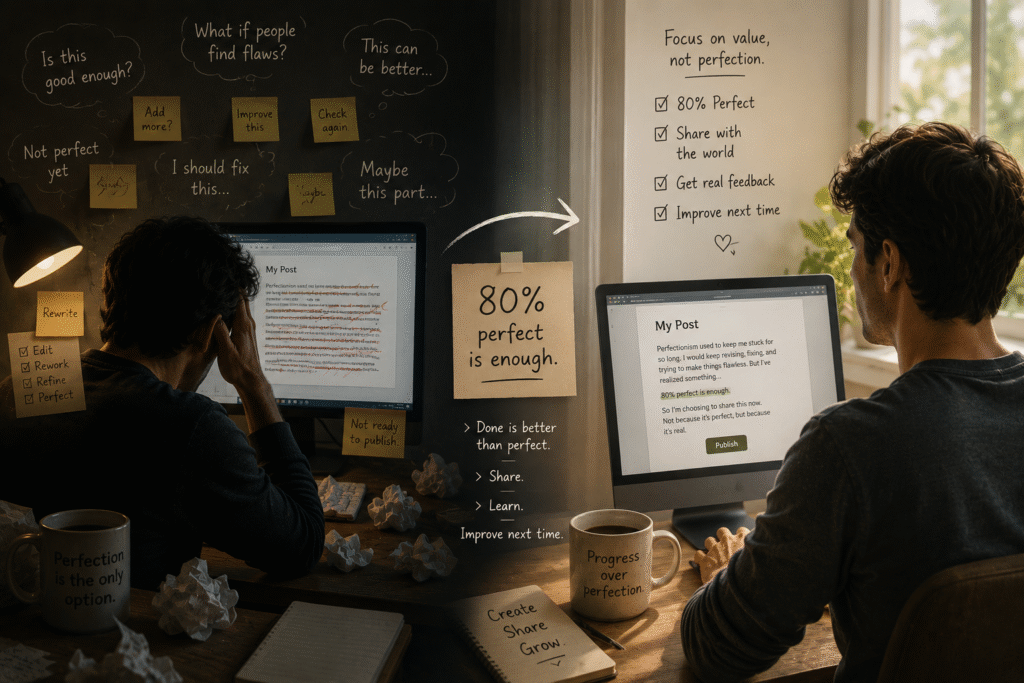
I call it the 80% perfect rule.
Perfectionism keeps asking: ‘What if something is wrong?
Now, this is going to make sense if you have perfectionism tendencies in you. To those of you who don’t have it, all of this might just sound silly.
See, for us perfectionists, these words really resonate: “leave no stone unturned” … doesn’t it? Don’t those words sound like music to your ears?
How do I know? Because they sound like music to my ears too.
To us perfectionists, the whole idea is: if we leave no stone unturned, then we have maximum chances of safety.
So, let’s say you are creating something, a project or artwork or writing a book, you want it to be 100% perfect (from your end) so that when it goes out into the world, there are fewer chances of any error or mistake showing up that is going to make you feel horrible, because now you can’t change it.
We just don’t like the idea that we are going to find ourselves in a situation where we will see one little error when something that we created is out in the world. That makes us feel horrible.
But why?
Because we feel unsafe.
We feel that one error might cost us a whole lot. Our work will not succeed. Somebody will see it and judge us. They will think it’s of lesser quality. They might think we did not put in enough effort.
All these thoughts and more haunt us continuously… and our way to have any sense of control over it is perfectionism.
So, where does the whole 80% perfect rule come in?
The idea is: if you have gone through all of these things, you have noticed you usually finish a work or a project, and then comes the perfectionism.
You spend hours trying to fail-proof it, flaw-proof it. And that’s where most of the time and energy goes, and it makes you overthink, drains your energy, and doesn’t ultimately lead to anything fruitful in the real world.
Isn’t it?
“The exhausting part is not creating the work. It’s the endless attempt to fail-proof and flaw-proof it before allowing it to be seen.”
So, it’s usually when the project or work is majorly done, around 80% done, that our perfectionist mind kicks in. It then has just one job left to do: make it 100% perfect.
The problem is that 80% of the actual work doesn’t waste your energy or time. It happens relatively quickly. The remaining 20% of trying to fail-proof and flaw-proof it wastes 100% of our time and makes us go nuts.
This is where we use the 80% perfect rule.
When you’ve finished a project and it’s decently well done and edited, ask yourself this question:
Is it 80% perfect?
If your mind says “yes,” then allow yourself the courage to share your work with the world in that state, in an 80% perfect state. That’s it. Don’t go on the fail-proofing rampage… that usually is useless and a huge waste of time, energy, and brainpower.
You see, the reason this technique has been working for me is because once my mind has clarity that it’s 80% perfect, its need for safety is articulated and validated clearly.
The mind just wants to feel safe. So now it knows, “okay, it’s 80% perfect,” which is quite safe for its standards.
So, it allows the mind to loosen its grip for control and allow it to be shared. It allows you to be vulnerable with your work in the world.
The mind feels okay since it’s 80% perfect. If the work goes out into the world, most of the things are working, and whatever is not, we are going to slowly receive feedback and improve in the next work, but not on this one.
You don’t have to try to fix everything on “this one”… you can learn what works and what doesn’t work and improve on the “next one”… that way you never overthink or overdo, and you learn and improve from real-world feedback.
You’ll notice if you do this, much of your work will not need many adjustments at all, and you’ll see the world loves your “80% perfect” work much more than your over-perfected work… because there’s a lot of humanity in it.
The more you apply this rule in different areas of your life where your perfectionism kicks in and bothers you, you’ll see this will bring you so much harmony and ease while creating and sharing your work, and it will greatly reduce the disharmony that comes from overthinking and trying to get things perfect.
Harmony comes when you allow yourself to be just a little less than perfect.
“Harmony comes when you allow yourself to be just a little less than perfect.”
If what I have shared resonated with you, I would love to hear what came up for you. You are welcome to comment on this post.
If this brought something into awareness for you, you may find this next part relevant.
Many of us move through life appearing steady and capable on the outside, handling our responsibilities, yet internally something feels slightly unsettled, a subtle tension, a sense that something is not fully aligned.
Often, this is part of a deeper inner shift.
My work is for those who are already functioning well in their lives, yet feel drawn to understand their inner experience more deeply and restore a deeper sense of inner harmony within.
I offer a small number of one-hour complimentary discovery conversations over Zoom, depending on my current capacity. This is a one-time exploratory conversation.
These are quiet sessions where we look at what you are currently experiencing and what may be creating that inner disharmony.
During this conversation, we simply explore what is present for you and see whether my work may be supportive. There is no pressure or obligation.
This allows each conversation to receive my full attention.
If you feel a clear resonance with this, you can explore booking a discovery call with me here.
There is no rush to fix anything. Only a quiet return to yourself, in your own time.